
 Update: Emblematic Mining Resistance Case in Honduras – International Legal Solidarity*
Context and Overview 2 Juan López Case: Lack of Meaningful Progress 3 Material Perpetrators and Case Details 4 Key Hearing 4 Delays and Deficiencies: Absence of Charges Against Intellectual Authors 6 Environmental Crimes Case 7 First Conviction 7 Senior Executives Prosecuted 7 Fraud and False Documents Criminal Case 9 Administrative Advances and Complaints 10 The non-renewal of Ecotek’s mining concession contract 10
Administrative Illegalities and Institutional Complicity Denounced Through Two Writs of Amparo 11 International Solidarity 12 IAHRC Precautionary Measures 13 Conclusions: 2025 as a Decisive Year in a Context of Dispute, Violence, and Resistance 13
* A report of the National Lawyers’ Guild International Committee / Task Force on the Americas*
* Compiled by Jackie McVicar with Emily Yozell and approved by the local committee in Honduras 2/2026
Context and Overview
The NLG-IC has been an active member of the Observatory for the Freedom of the Guapinol River Defenders (Observatory) since 2000 in the lead up to the 2021-2022 trial of eight arbitrarily detained water defenders and prisoners of conscience from San Pedro and Guapinol, department of Colon, near the Bajo Aguan region of Honduras.1 The defenders, organized in the Tocoa Municipal Committee in Defense
of the Commons (CMDBCPT), were criminalized by the Honduran State and the Los Pinares mining company (part of Emco Holdings) for defending the Carlos Escaleras National Park and surrounding area from an extractive mega project comprised of an open-pit iron oxide mine and processing plant, and a thermoelectric pet-coke energy-generating station. Organizations from the Observatory continue to accompany and represent the CMDBCPT, as well as their attorneys from the Bufete Justicia para los Pueblos (BJP), within the Inter-American Human Rights System, and through international legal advocacy at the UN, trial monitoring, and reporting on criminal proceedings of the Defenders in Honduras.
To understand the Honduran Judicial and Administrative proceedings regarding the work of the CMDBCPT during 2025, one must consider the broader power structure that shapes the territory and the systematic use of violence to silence defenders of their land, water, and livelihoods in opposition to the Emco Holdings megaproject.
Marked by heightened partisan political dynamics surrounding the national elections held in late November 2025, the struggles for control over land and the commons were characterized by an escalation of intimidation, criminalization, and violence. Investigations into corruption by environmental defender Juan López and municipal council members were publicly exposed during Juan’s term in office, before his murder. Despite sustained calls for accountability and justice, Mayor Adan Funes has not been charged with any crimes, including the murder of Juan López.
To date, only the three alleged hitmen were charged in the weeks following Juan’s murder in September 2024 and are set to face trial in June 2026 for conspiracy and murder. Attorneys from BJP are co-accusers on behalf of the CMDBCPT in this case, as well as beneficiaries of Precautionary Measures.
Public calls for the arrest and prosecution of those who ordered and financed the crime triggered backlash that manifested in an increase in threats, intimidation, and smear campaigns against human rights defenders in the CMDBCPT and organized communities in the Bajo Aguan throughout the year.
1In 2018, residents and neighbors of Guapinol erected a “Camp in Defense of Water and Life” on a public path as a protest against the contamination of their drinking water and destruction of portions of a national park by a mining project. The peaceful assembly was met with violence. Numerous arrests and judicial proceedings ensued, and nine Guapinol community defenders were sent to pretrial detention on September 1, 2019, where they remained arbitrarily for 3 years, until found not guilty. Subsequently, four of these defenders have been assassinated.
Although the Emco extractive/energy/mining megaproject was originally authorized by the Narco- State through irregular, illegal, and fraudulent procedures, including the use of falsified documentation and in open contradiction to the popular will expressed through repeated town hall assemblies since 2016, the year 2025 saw important advances toward accountability through the courts by way of two criminal proceedings for environmental damages and use of illegitemate documents. Sustained efforts by the CMDBCPT and legal team resulted in judicial prosecutions following the murder of Juan López and in response to strong international and national pressure.
Throughout 2025, the CMDBCPT, accompanied by national and international allies, (including NLG) unified their demands for justice for the murder of Juan López; called for effective protection for human rights defenders and the full implementation of comprehensive and collective precautionary measures within the framework of the IAHR system, as well as the effective enforcement of Decree 18-2024 to restore the Carlos Escaleras Botaderos Mountain National Park and definitively terminate mining within protected areas of Honduras.
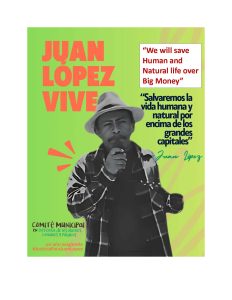
This report highlights the principal advances, setbacks, and challenges faced in the 2025 criminal processes linked to territorial, environmental, and human rights defense led by the CMDBCPT, and supported by the Observatory, to document events and seek accountability and justice moving forward.
Assassination of Juan López Case: Lack of Meaningful Progress
Progress towards justice for the murder of environmental defender Juan López has been slow, and his death continues to have a profound impact on his family and colleagues, the Catholic Church, and community organizations in Tocoa and the Bajo Aguán communities he accompanied. His legacy of faith, leadership, and commitment sustains the demand for comprehensive justice, which has rallied allies globally.
In response to calls from the CMDBCPT for an independent investigation into the murder of Juan López, supported by national and international organizations, the Attorney General established a special team of senior prosecutors in the days following Juan’s death. This call reflected widespread distrust of the local Tocoa Prosecutor’s Office, which has a documented record of criminalizing human rights defenders and failing to advance key investigations, including murders of other defenders in Guapinol.
Despite what appeared to be a solid start, however, more than 15 months after Juan López’s assassination, and despite the expectations generated by the creation of the special team, the Public Prosecutor’s Office has demonstrated neither the capacity nor the political will to pursue criminal proceedings against the intermediaries and intellectual authors of this crime, thereby reproducing the pattern of impunity observed in the case of Indigenous Lenca defender Berta Cáceres in 2016, and countless other human rights, environmental and land defenders in Honduras.
It is worth noting that in conjunction with COPINH, which Defender Berta Caceres co-founded and led at the time of her murder, the Inter American Commission for Human Rights implemented the Independent Group of International Experts (GIEI for its acronym in Spanish) in 2025. The IAHRC-sanctioned working group dove deep into Berta’s case, conducting interviews and reviewing case files, and reported in January 2026 that the State of Honduras had responsibility by action and omission for the crime against the land defender, since authorities had prior knowledge of threats and even the murder plot, yet failed to take preventive measures or to act decisively after the crime. The group also reported on “selective accountability”, in which convictions of material authors were presented as sufficient, while structural, intellectual, and financial responsibilities were left untouched. The GIEI stressed that patterns of impunity are not incidental but structural, and that without prosecuting those who ordered, financed, and enabled the crime, and without addressing the legal and institutional conditions that allowed it, the risk of repetition remains, particularly for Indigenous and environmental defenders in Honduras, as is evident in the Juan Lopez case, who many consider similar to the context and leadership of Berta in the struggle to defend the river.
Material Perpetrators and Case Details
In 2025, the criminal case for the murder of Juan Lopez moved forward against three alleged hired hitmen. The preliminary hearing concluded in August 2025, having been postponed several times at the request of the Public Prosecutor’s Office due to a lack of progress in completing the expert reports needed to substantiate the case. During the process, the Public Prosecutor petitioned the court to add the charge of conspiracy, demonstrating that the crime involved planning and coordination in order to be carried out. This confirms the existence of other actors who ordered and financed the murder and who remain at liberty.
On September 9, 2025, the National Jurisdiction Court of First Instance in San Pedro Sula issued an order to proceed to trial against the three defendants, transferring the case to the Second Chamber of the National Sentencing Court for Organized Crime, Environmental Crimes, and Corruption in Tegucigalpa (Case File TS/JN-7-61-2025).
By order dated November 11, 2025, the court appointed two public defenders, attorney Onix Jakeline Manzanares and attorney Brallan López Sosa, to represent alleged shooter Óscar Alexi Guardado Alvarenga, following the resignation of his previous counsel. The other two defendants are represented by Selvin Maldonado, who notably also represents Misraim Tábora Izaguirre, a municipal employee of Tocoa implicated in the criminal case for usurpation of functions related to environmental crimes against Carlos Escaleras National Park (see below).
Key Hearing
After receiving the case file, the Tribunal in Tegucigalpa scheduled two hearings: an Examination of Proceedings Hearing, held on November 19, 2025, and an Evidence Submission Hearing, initially set for December and later rescheduled to January 8, 2026, due to the illness of defense attorney Selvin Maldonado.
In Honduras, the Evidence Submission Hearing is a critical stage of criminal proceedings, during which the parties formally present the evidence to be examined at the oral and public trial. Its purpose is to determine which evidence will be admitted, ‘ensuring the right to defense, the principle of adversarial proceedings, and equality of arms’.
The Public Prosecutor presented its incriminating evidence, and the defense presented exculpatory evidence. The private prosecution—in this case, the family of Juan López and the CMDBCPT— represented by BJP, also submitted evidence. Testimonial evidence (victims, witnesses, police officers, public officials), expert evidence (technical, scientific, forensic, environmental, financial, and contextual), documentary evidence (reports, records, official documents), and material evidence (objects, samples) were admitted. Only the admitted evidence may be presented and assessed at trial.
This hearing is fundamental and requires close monitoring and technical observation, as it defines the true scope of the trial and can significantly strengthen or weaken both the prosecution and the defense. The Observatory requested and was granted the right to observe proceedings through the public transmission on Facebook Live of the Honduran Judiciary (https://www.facebook.com/PJdeHonduras). The Public Prosecutor attempted to limit the evidence to the material execution of the crime, without addressing the broader context in which Juan López—an environmental defender subjected to constant threats—was murdered. For this reason, the participation of the private prosecution and international observation is essential to ensure that the court understands this crime in its full context, and not solely the responsibility of the three hired gunmen.
During the January 8, 2026, hearing to propose evidence to be used during trial, the following was proposed by the Public Prosecutor and the Private Accusation. The Tribunal accepted it in its entirety. It is worth noting that neither defense team proposed any evidence. In Honduran law, evidence can be proposed at a later date if deemed important to the case, so there may still be opportunities for either the accusation or defense to propose other evidence.
- Testimonial evidence
○ Statements from police officers involved in the investigation
○ Statements from officials who participated in initial investigative actions; ●
- Forensic and technical expert reports
○ Autopsy and forensic pathology report
○ Ballistics analysis
○ Crime scene reconstruction;
- Documentary evidence
○ Police reports and investigative records
○ Chain-of-custody documentation;
- Material evidence
○ Physical evidence collected at the crime scene (weapons-related evidence, projectiles, etc.);
- Context expert reports
○ Analysis of Juan López’s role as an environmental defender
○ Documentation of threats, harassment, and criminalization prior to the murder
○ Assessment of patterns of violence against defenders in Tocoa and Bajo Aguán;
- Linkage and authorship analysis
○ Expert analysis establishing coordination, planning, and command responsibility ○ Evidence supporting the existence of intermediaries and intellectual authors;
- Telecommunications evidence
○ Analysis of phone records and communications between suspects
○ Geolocation and call-data analysis to establish coordination and timelines;
● Financial and economic analysis
○ Evidence related to the possible financing of the crime
○ Indicators of payments or logistical support linked to the perpetrators;
● Testimonial evidence
○ Statements from family members
○ Statements from community members and fellow defenders
○ Testimony from members of the CMDBCPT;
- Documentary evidence
○ Prior complaints and reports filed by Juan López and the CMDBCPT
○ Documentation of precautionary measures and protection requests
○ Reports from human rights organizations and media investigations;
- International and institutional documentation
○ IACHR precautionary measures and related compliance reports
○ Human rights reports contextualizing the risk faced by environmental defenders.
Delays and Deficiencies: Absence of Charges Against Intellectual Authors
More than a year after the murder, progress regarding the intellectual authors remains minimal or nonexistent. Despite the gravity of the case and sustained public pressure, those who ordered and financed the murder of Juan López remain unpunished, perpetuating the structural impunity that has characterized violence against environmental defenders in Honduras.
It is worth noting that an investigative report by Contracorriente2 publicly reiterated that Juan López, together with other municipal council members, had denounced corruption involving Mayor Adán Funes and municipal employees prior to his murder. The report also linked Funes to violent criminal networks, including Los Cachos. Despite ongoing allegations, neither Funes nor any other senior official has been charged, while high-ranking officials and media outlets continue to promote his efforts to rehabilitate his public image.
Environmental Crimes Case
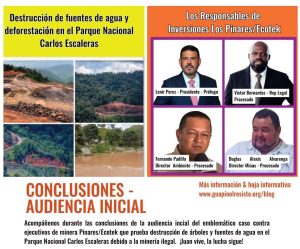
Following the murder of Juan López in September 2024, the Public Prosecutor’s Office formally brought criminal charges against 13 public officials and executives of Inversiones Los Pinares, S.A., and Inversiones Ecotek, S.A., which both form part of the Emco Group. Charges range
2 https://contracorriente.red/2025/08/18/juan-lopez-investigo-corrupcion-en-la-alcaldia-de-adan-funez antes-de-ser-asesinado/
from Illegal extraction of minerals (mining activities without proper licenses) to deforestation and destruction within protected areas; harm to ecosystems, contamination of water sources, and impact on biodiversity; and abuse of authority by public officials involved in permitting processes and failures of law enforcement.
To date, one individual has been convicted while the others remain at differing stages of the criminal process. Despite repeated calls by the CMDBCPT to consolidate the cases into a single proceeding, so as to reflect the coordinated nature of the actions from the municipal to the corporate level, the cases remain fragmented. Notably, after more than 14 months under an international arrest warrant, Lenir Pérez, President of Grupo Emco Holdings, has returned to Honduras and his summons to voluntarily appear before a Honduran court to face criminal charges has been twice rescheduled and now set for March 27, 2026.
First Conviction
Otoniel Flores Mira, a former employee of the Environmental Unit of the Tocoa Municipal Office, was convicted by a National Jurisdiction Sentencing Court on April 8, 2025, of usurpation of public functions, in real concurrence, to the detriment of the public trust, after pleading guilty to the charge. During the proceedings, Flores Mira admitted that he had unlawfully issued permits authorizing Inversiones Los Pinares and Inversiones Ecotek to cut trees in connection with their mining project.3
The close personal and political ties between the accused and the outgoing mayor of Tocoa, Adán Funes, underscore the coordinated nature of the scheme to benefit Pinares/Ecotek.
Senior Executives Prosecuted
On May 8 2025, Judge Jose Abraham Rosa Sanchez of the Court of National Jurisdiction in Tegucigalpa issued formal indictments against three senior executives of Pinares/Ecotek: Víctor Lorenzo (Legal Representative), Fernando Padilla (Superintendent of Environment), and Douglas Alvarenga (Superintendent of Mines) for the alleged crimes of illegal exploitation of natural resources and serious damages to the Carlos Escaleras Botaderos Mountain National Park. This marked the first time in Honduras that senior executives of a mining company have faced criminal prosecution for environmental crimes.
In his ruling, Judge Rosa Sanchez characterized the case as emblematic and established a key legal precedent for holding extractive companies and their leadership criminally accountable. He determined that the accused acted with knowledge and intent and identified indications of
3It is also noteworthy that Filemón Flores Mira, Otoniel Flores Mira’s brother, has been charged in the same case and has indicated his intention to plead guilty. In addition, Filemón’s wife, Norma Agripina García, the Municipal Secretary of Tocoa, has been accused of falsifying public documents, specifically by altering the official record of a municipal town hall meeting in order to satisfy the legal requirements for environmental permits.
collusion between public officials and the company, citing as precedent the recent conviction of Otoniel Flores for illegally authorizing tree cutting within the park.
Evidence considered included testimony from ATIC agents, technical and environmental expert reports, and official documentation from the ICF and INHGEOMIN, establishing the construction of a road within the park’s core zone, mineral extraction without permits, the installation of a crushing plant and waste dump, and other works carried out without the required legal and environmental authorizations. The judge concluded that these actions caused significant damage to the ecosystem, affecting the watershed and areas of high biodiversity within the Mesoamerican Biological Corridor.
Although the Public Prosecutor and the CMDBCPT, represented by the BJP as private accusers, requested pretrial detention, the court imposed alternative measures, citing the financial bonds posted by the defendants. The Judge rejected the defense’s attempts to minimize corporate responsibility and instead blamed local cattle ranchers for the devastation of the national park. He also dismissed an expert report they presented for having submitted it late.
The preliminary hearing was scheduled for June 11, 2025, but did not take place because the defense filed an appeal against the formal indictment issued in May. As of the date of this report, the appeal remains unresolved, causing further delays in the proceedings, and the private prosecution has not yet been formally notified of the appeal to respond.
On January 13, 2026, an ad hoc hearing was held before Judge Rosa Sánchez of the National Jurisdiction Court in Tegucigalpa at the request of Lenir Pérez, President of Grupo Emco Holdings. In May, Perez also indicated he would voluntarily present himself, but he did not. During the hearing, Pérez’s legal counsel sought the suspension of the international arrest warrant and the migration alert to allow him to return voluntarily from Miami to Honduras to face the charges. Despite objections raised by the CMDBCPT, Judge Rosa Sánchez granted the request and scheduled Pérez’s initial court appearance for January 30, 2026, noting that if he does not show up, the measures would be reinstated. Following this resolution, Judge Rosa Sánchez was promoted to the National Jurisdiction Tribunal.
On January 28, the Court notified the plaintiffs that the hearing would be postponed until February 13, 2026 (now March 27th) at the request of the defense attorney, Walter Leonel Ramirez Garcia, who presented medical notes justifying his illness.
Perez’s hearing is set to take place just days after the presidential inauguration of National Party’s Nasry Juan Asfura Zablah, whom U.S. President Donald Trump publicly endorsed days before the election, stating, “This will be your new president.” On the same day, Trump also announced his intention to pardon former Honduran president Juan Orlando Hernández, who was convicted in a New York court in 2024 on major drug trafficking charges. The timing of these developments has raised serious concerns regarding political interference and the possibility that Lenir Pérez may have secured favorable judicial conditions amid shifting political power.
Fraud and False Documents Criminal Case
In April 2025, the Public Prosecutor’s Office in Honduras filed formal charges against three individuals in connection with a scheme to fraudulently obtain environmental licenses for the Inversiones Los Pinares/Ecotek mega project in Tocoa, Colón. The defendants are:
- José Ernesto Vindel Wainwright, legal representative of Ecotek and also legal counsel for ASECOAH, a firm contracted by the Honduran state to carry out environmental impact studies. ASECOAH has conducted controversial studies linked to projects with significant environmental impacts, and its direct connections to Grupo Emco suggest Vindel’s key role in a network of corporate interests behind strategic megaprojects.
- Kenia Patricia Cortés – former legal representative of Inversiones Los Pinares on behalf of the international law firm Aczalaw, a high-profile law firm with strong ties to business and political sectors in Honduras, founded in 2002 by Carlos López Contreras, foreign minister of the de facto government after the 2009 coup, former ambassador to European countries, and former representative of Honduras to the International Court of Justice, and Armida Villela, presidential appointee during the Ricardo Maduro administration (2002-2006), whose brother Miguel Ángel Villela Meza was convicted of drug trafficking crimes in Colombia.
- Norma Agripina García, Municipal Secretary of Tocoa, a key political and administrative figure whose close relationship with Adan Funes has been central to facilitating irregular administrative actions. She is accused of falsifying municipal records, including altering the official minutes of a 2016 town hall meeting to create a false record of community approval needed to secure environmental licenses. This document was then allegedly used by the Legal Representatives of Ecotek and Pinares to obtain required environmental licenses.
The criminal allegations against the three defendants focus on the alteration and misuse of a 2016 cabildo abierto (Municipal Town Hall Assembly) minutes, which were then submitted to the Secretariat of Natural Resources and Environment (SERNA) as part of the environmental license application process, even though the affected communities had never given consent and repeatedly expressed opposition to the megaproject.
According to the Public Prosecutor’s Office, the three defendants acted in coordination to present falsified documentation as a legal requirement to obtain environmental permits. Evidence supporting this claim emerged when the Technical Agency for Criminal Investigation (ATIC) seized the falsified record from SERNA’s files in May 2023, in response to a complaint originally filed by the CMDBCPT.
Following the initial hearing, the National Jurisdiction Court in San Pedro Sula issued a formal indictment against all three defendants, affirming sufficient evidence presented by the Public Prosecutor’s Office to support the charges of document falsification and misuse. Due to ongoing appeals, the preliminary hearing has not yet taken place.
This case is emblematic of how fraudulent administrative actions have facilitated the unlawful installation and operation of the megaproject, contributing to broader patterns of regulatory failures, environmental harm, and violations of community rights. Defender Juan López had publicly denounced and filed legal complaints against these irregularities before his murder in September 2024, but the State took no action until months after his murder.
Administrative Advances and Complaints
The Grupo Emco Holdings mega project consists of three water concessions, two open-pit mining concessions (called ASP and ASP2 controlled by “Inversiones Los Pinares”), a mining concession to operate a pellet plant (controlled by Inversiones Ecotek), and a petcoke thermoelectric project (controlled by Inversiones Los Pinares) that will serve to primarily provide electricity to run the mining operation.
 The non-renewal of Ecotek’s mining concession contract
One of the most important events of 2025 was the decision by the Honduran National Institute of Geology and Mines (INHGEOMIN) on October 19 to cancel Ecotek’s mining rights (to operate an iron-ore processing plant) through the non-renewal of its processing plant concession. According to the company, its controversial petro-coke thermoelectric energy generation project was designed to provide the electricity needed to run the processing plant, the largest of its kind in Central America.
The company was notified on October 23, 2025, of INHGEOMIN’s resolution and immediately announced its intention to appeal it through the Contentious-Administrative Court. The CMDBCPT notes that INHGEOMIN’s firm and clear resolution is based on the serious technical flaws in the company’s application that would make any future authorization inadmissible, but for fraudulent actions of the new regime.
Despite this initial resolution, it is undeniable that the company is putting pressure on INHGEOMIN to revoke it, and with the arrival of Oscar Felipe Garcia Lopez, the newly appointed INHGEOMIN Director, this will be a major point of controversy.
The ASP and ASP 2 iron ore open-pit mining concessions expired in 2024 and were not renewed by INHGEOMIN since Decree 18-2024 was passed into law in May of that year. The law seeks to protect the Carlos Escaleras National Park and all forest reserve areas affected by environmental damage resulting from mining activity, and is a result of steadfast advocacy by the Committee. The law remains in force but has not yet been implemented and is at risk of being struck down by a new government to protect private interests.4 Although the decision not to renew the concession was challenged by Inversiones Los Pinares, the appeal was declared without merit, on the grounds that Decree 18-2024 is not retroactive.
4 8 de julio – Es hora de que se cumpla el decreto 18-2024. – OACNUDH
Administrative Illegalities and Institutional Complicity Denounced by Two Constitutional Challenges (Writs of Amparo)
The Constitutional Chamber of the Supreme Court of Justice has been excessively slow in resolving appeals filed by the CMDBCPT to guarantee constitutional rights through writs of amparo.
June 2024: The CMDBCPT filed an Amparo action against the Secretariat for Environment and Natural Resources (SERNA) for instructing the Tocoa Mayor’s Office to convene an Open Town Meeting as a procedural requirement to advance the Ecotek Pet-Coke Thermoelectric Energy Generating Plant, despite the fact that pet-coke is not a regulated substance in Honduras. SERNA issued this instruction without first resolving the formal objections submitted by members of the public and affected communities. This action followed a September 25, 2023 ruling in which SERNA ordered consultation on the oil-coke power plant, even though the toxic substance in question is not regulated under national emissions standards for electricity generation.
June 2025: The CMDBCPT and the Agrarian Platform of the Bajo Aguan presented a second Writ of Amparo against SERNA, INHGEOMIN, and the Tocoa Mayor’s Office for denying civic participation in the license-granting process. This legal action denounces omissions and acts by municipal and central government authorities that violate fundamental rights, including due process, citizen participation, the right to water, a healthy environment, health, and human dignity.
This petition identifies several specific violations:
- INHGEOMIN: The Honduran Institute for Geology and Mining (INHGEOMIN) rejected and excluded citizen participation in the mining concession processes and approved the mining concession despite clear and repeated community rejection expressed in at least six Open Town Hall (Cabildo Abierto) / Municipal Assemblies. On May 14, 2025, INHGEOMIN issued a resolution rejecting community opposition to the renewal of the mining contract for the “La Ceibita” mining project (the Ecotek pelletizing plant), thereby legitimizing a contract marked by serious irregularities, including falsified documents, the absence of a definitive environmental license, and operations in unauthorized areas. This resolution ignored both the communities’ legally protected right to oppose extractive projects and the collective will expressed in the 2019 Cabildo Abierto meeting.
- SERNA: The Secretariate allowed the project to proceed without the legally required environmental authorization. Ecotek never obtained a valid Environmental License, operating instead with a short-term provisional license, which does not comply with legal requirements.
On May 23, 2025, the CMDBCPT reported that SERNA, under Minister Lucky Medina, refused to respond to a Citizens’ Opposition filed against granting Ecotek Pelletizing
Plant’s request for an Environmental License. At the time of this refusal, Ecotek’s mining contract had expired in December 2024 and could not be legally renewed.
To date, the company never held a valid environmental license and has violated the terms of its contract with INHGEOMIN by submitting falsified documents.
For several years, the CMDBCPT publicly denounced and filed formal complaints with SERNA regarding the project’s illegal operation under a provisional license rather than the legally required definitive license. SERNA failed to respond to these complaints. The undue administrative delay maintained by SERNA since 2020 has been formally denounced by the CMDBCPT to the Public Prosecutor’s Office as administrative malfeasance and a breach of public officials’ legal duties.
- TOCOA MAYOR: Under Mayor Adán Funes, the Tocoa mayor’s office authorized permits for the Pinares/Ecotek projects despite sustained community opposition and serious social and environmental harm, including the murder of environmental defender Juan López.
The writ of amparo sustains that the rights of citizens were not protected when the Tocoa Mayor’s Office extended, in January 2025, operating permits for extractive projects within the protected area of the national park and for the Ecotek pelletizing plant. At the time these permits were extended, neither the mines nor the pelletizer held valid mining rights to operate in 2025, as the concessions had already expired. Moreover, the pelletizer and the ASP and ASP2 mining projects had previously been shut down by the authorities, making the extension of operating permits unlawful.
- This June 2025 writ has not yet been admitted by the Constitutional Chamber for review. National and International Solidarity
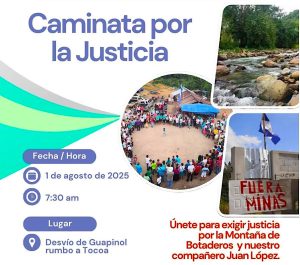
Between the August 1, 2025 commemorative march on the seventh anniversary of the establishment of the Camp for Water and Life in Guapinol to resist the megaproject, the August hearings, and the various activities in Tegucigalpa and Tocoa to mark the first anniversary of Juan López’s murder, a national and international solidarity campaign was launched to coincide with the actions led by the Committee and the Catholic Church to demand justice for Juan and the Carlos Escaleras National Park. This included the inauguration of the Juan López Environmental Award presented by the Episcopal Conference and the Catholic University of Honduras, a march and a mass at the Basilica of Suyapa in Tegucigalpa, a protest camp in the central park of the city of Tocoa where artistic and political activities were held, as well as religious and cultural activities in the church where Juan was murdered, including the screening of a new documentary, “Juan, Beloved Disciple of the People”. Amnesty International also included Juan López’s case in its 2025 “Write for Rights” campaign as one of eight emblematic cases it highlighted for that year, collecting hundreds of letters to authorities and messages of support for Juan’s family. A podcast was launched with the international campaign “Life Hangs by a Thread,” while a radio drama was produced by the Committee with the support of La
Ilimitada and the Center for Women’s Rights. In August and September, a series of online forums also took place, to honor the life and legacy of Juan Lopez, including the participation of national and international experts, poets and writers, Committee members, and the legal team. It is worth noting that there was almost total silence on the part of the Honduran state, even from members of the Libre party, many of whom worked closely with Juan and who had previously denounced the murder, did not dare to say anything to demand justice a year later.
These actions at the national and international levels renewed attention to the case, but also reignited smear campaigns against the members of the Committee and the priests who support the cause.6 To date, the prosecutor’s office has never investigated the defamatory reports and publications, and the journalist, who is also a correspondent for several major media outlets in the country, continues these media attacks. He has been denounced by the Committee both publicly and to the authorities without consequence.
IAHRC Precautionary Measures
The NLG IC, through the Observatory, has maintained an important advocacy relationship within the IAHR system, particularly our representation in petitions for Precautionary Measures. We have accompanied the local Committee members and other community members during Honduran country visits by Commissioners, as well as specific hearings with the Commission in Washington. In 2025, we requested extending Precautionary Measure 137-2023 to include 12 more defenders due to the situation of greater insecurity at the local level. Unfortunately, there has been a lack of collective and effective compliance by Honduran authorities to ensure the protection of the identified defenders, causing some to seek refuge outside the region. Notwithstanding Honduran officials’ assertions of compliance with the measures, there have been few advances to address the key environmental and human rights concerns, resulting in continued threats received by defenders.
Conclusions: 2025 was a Decisive Year in a Context of Dispute, Violence, and Resistance
Since 2015, the CMDBCPT has denounced the imposition of a mining-energy megaproject operated by Inversiones Los Pinares and Inversiones Ecotek, part of the Emco Holdings conglomerate owned by Lenir Pérez and Ana Facussé. The defense of water, territory, and human rights has come at a high cost to communities, including criminalization, threats, systematic violence, including assassinations, most recently the September 2024 murder of the Committee’s coordinator, Juan López.
5, including NLG IC member Emily Yozell, among others.
6 Contracorriente reported that Héctor Madrid, one of the main contributors to the smear campaign against the defenders and religious leaders, had previously received land from the mayor of Tocoa, Adán Funes, indicating a close relationship between the two and a motive for the journalist to defend the now outgoing mayor, who has also been repeatedly denounced by the Committee.
The economic and political power of the Pérez-Facussé family has expanded rapidly, with interests in infrastructure, energy, and transportation, while the historical record of the Dinant Group (founded by Miguel Facussé, Ana Facussé’s father) in the Bajo Aguán has been marked by serious human rights violations and the use of violence for territorial control. Similar patterns have emerged in Guapinol and in communities opposing the Emco project.
Between late 2024 and throughout 2025, violent evictions intensified in the Aguán, allegedly carried out by the criminal group Los Cachos, linked to Adán Funes, with the aim of displacing peasant communities and favoring Dinant. Following repeated complaints, charges of forced displacement were eventually brought against two members of this criminal structure.
This context is particularly significant at a critical political juncture, with contested national election results, a new regime and a high degree of institutional uncertainty, particularly within the Office of the Attorney General. We expect abrupt changes and adverse challenges for the pursuit of justice. At the same time, shifts in the United States administration have had a notable impact on Honduras’s social, political, and economic situation, while rising insecurity has further affected the country as a whole.
Against this backdrop, 2025 emerged as a decisive year in the struggle for control over land and the commons. As expressed by the Committee and allied organizations, only through greater organization, coordination, and collaboration among communities, social movements, and civil society will it be possible to build sustained resistance to these dynamics of violence and impunity.
With a new 2026 right-wing administration, supported by Trump, and ongoing criminal proceedings, including the June 2026 trial of the alleged hitmen responsible for the murder of Juan Lopez, this year will continue to be a crucial year for sustained monitoring of these cases and the Defenders in the Bajo Aguan region.


